Manufacturing recruitment has a simple goal: put capable people in critical
roles before open positions slow the plant. Yet the work behind that goal
has changed. Employers now compete for technicians, machinists, engineers,
maintenance talent, and frontline leaders who can choose from several paths.
The answer is not to post the same job on more boards. A strong
manufacturing recruitment strategy connects workforce planning, clear job
design, focused sourcing, fast selection, and early retention. This guide
shows how to build that system.
Why Manufacturing Recruitment Stays Difficult—Even in a Cooler Job Market
Headlines can make hiring look easier when overall demand slows. However,
plant-level recruiting rarely follows one national trend. A company may
pause general hiring while still struggling to find controls engineers,
industrial maintenance technicians, CNC machinists, welders, quality
leaders, and experienced supervisors.
The long-term pressure remains clear. The Manufacturing Institute and
Deloitte project that U.S. manufacturers may need to fill
3.8 million roles by 2033. If current gaps persist,
1.9 million could go unfilled. Meanwhile, federal data
showed roughly 580,000 manufacturing job openings in July 2026.
Manufacturing roles that may need filling by 2033
Deloitte + MI
Roles that could remain unfilled if gaps persist
Deloitte + MI
U.S. manufacturing openings in July 2026
BLS JOLTS
Manufacturing Job Openings Rose in Mid-2026
Seasonally adjusted, thousands of openings
retrieved September 2026. Values may be revised.
Texas adds another layer. In a July 2025 Dallas Fed survey,
43% of manufacturers said they were trying to hire.
Employers most often pointed to a lack of applicants, missing hard skills,
and gaps between offered pay and candidate expectations. Therefore,
companies need a role-by-role plan—not a broad claim that “nobody wants to
work.”
Start With the Hiring Funnel, Not the Job Board
A hiring problem usually has a location. If few qualified people apply, you
have a reach, reputation, pay, schedule, or requirements problem. If many
candidates interview but few receive offers, your screening may be weak. If
offers stall, the process or package needs work. If people leave in 90 days,
recruiting handed off a promise that the job did not keep.
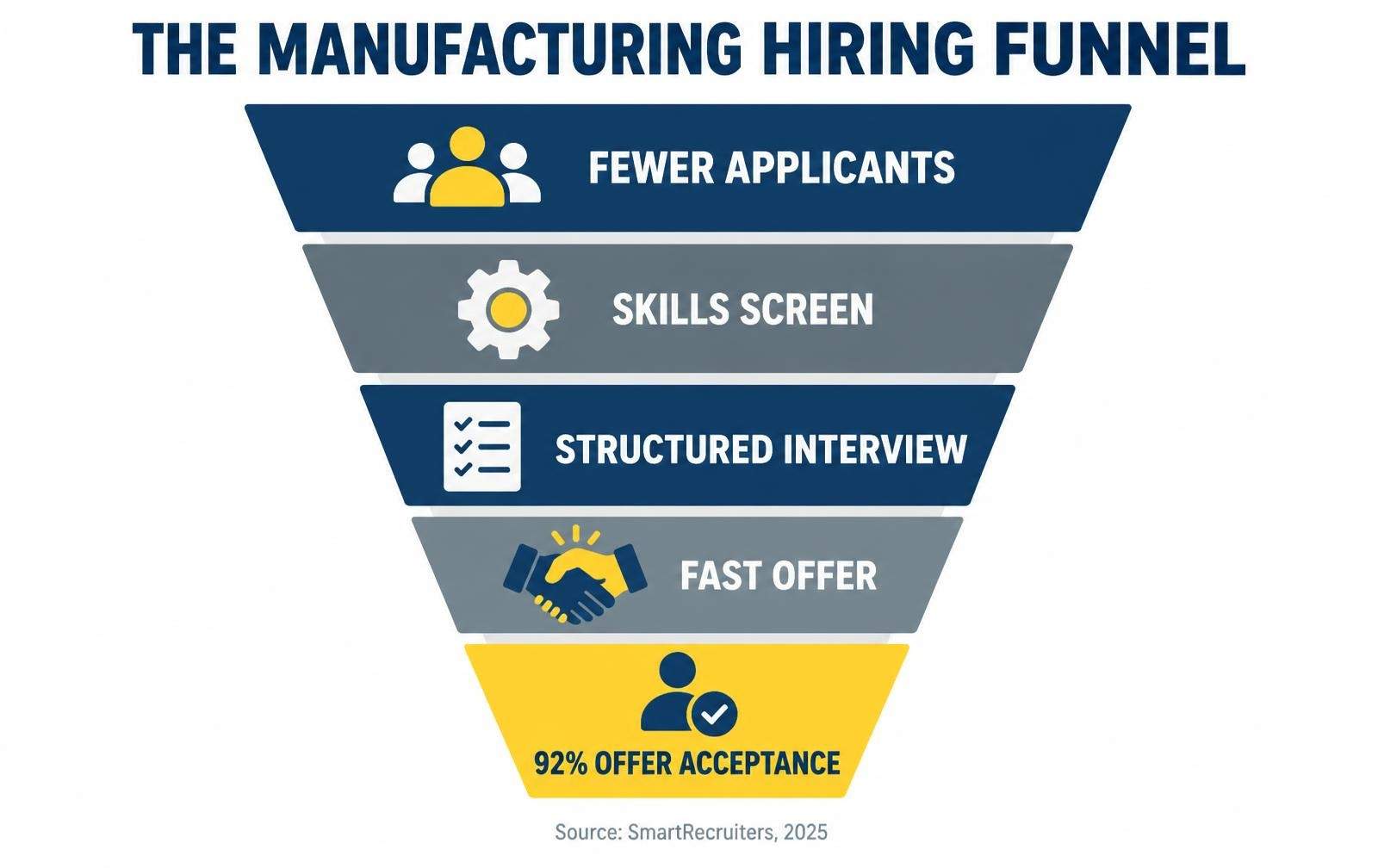
candidates who reach an offer often say yes. Source: SmartRecruiters,
2025.
Track Five Numbers Every Month
| Metric | What it tells you | Useful cut |
|---|---|---|
| Qualified applicants per opening | Whether your message reaches the right people | Role and source |
| Time in each hiring stage | Where candidates wait or drop out | Plant and manager |
| Offer acceptance rate | Whether the role and package compete | Shift and job family |
| 90-day retention | Whether expectations match reality | Source and supervisor |
| Quality of hire | Whether speed also produces performance | Six- and 12-month review |
A Seven-Step Manufacturing Recruitment Strategy
Step 1
Rank Roles by Business Risk
Do not give every vacancy the same priority. Start with the roles that
protect safety, uptime, quality, customer delivery, or scarce technical
knowledge. Then estimate the weekly cost of leaving each one open. This
turns hiring from an HR queue into an operating decision.
- List the roles that can stop or slow production.
- Estimate overtime, downtime, scrap, and delayed work.
- Name one accountable hiring owner for each critical role.
- Set a realistic decision date before sourcing starts.
Step 2
Write the Job Around Outcomes
Strong candidates want to know what they will own. Lead with the work,
shift, location, pay range, equipment, team, and first-year goals.
Separate must-have skills from trainable skills. A long wish list shrinks
an already small pool.
“Seeking a rock-star maintenance technician with 10+ years of
experience.”
“Keep three packaging lines running on second shift; troubleshoot
PLC, motor, and sensor faults.”
For more detail, use Kallie’s guide to
writing job descriptions that attract talent in Dallas-Fort Worth
.
Step 3
Build Several Talent Lanes
One source cannot solve every role. Use direct outreach for scarce
specialists, employee referrals for trusted local reach, schools and
apprenticeships for entry pipelines, and community partners for career
changers. At the same time, keep former employees and qualified past
applicants warm.
Employee Referrals
Best for trusted introductions and local networks.
Direct Sourcing
Best for passive technicians, engineers, and leaders.
Schools and Apprenticeships
Best for building skills before demand peaks.
Community Pathways
Best for veterans, career changers, and adjacent trades.
Step 4
Test Skills With the Work
A résumé shows where someone worked. It does not always show how they
diagnose a fault, read a print, respond to a quality issue, or lead a
shift. Use a short, job-relevant work sample and the same structured
questions for each candidate. Keep every test safe, legal, and tied to the
role.
Example prompt
“A line starts producing intermittent defects after a changeover. Walk
us through your first five checks and explain why you chose that order.”
Step 5
Run a Fast, Predictable Interview Process
Speed does not mean skipping diligence. It means deciding what each stage
must prove, booking interview time in advance, and collecting feedback
the same day. Tell candidates the full process at the start. If a manager
cannot attend, name a backup before sourcing begins.
- 1 20-minute screen
- 2 Skills and team interview
- 3 Decision within 24 hours
Step 6
Sell the Real Job, Not a Polished Version
Explain the shift, heat, noise, physical demands, schedule, overtime,
leadership style, and growth path before the offer. Show candidates the
work area when possible. A realistic preview may cause some people to opt
out, but that is useful. It protects 90-day retention and trust.
Step 7
Treat Onboarding as the Last Recruiting Stage
The first weeks confirm whether your recruiting promise was true. Assign
a trained peer, set 30-, 60-, and 90-day expectations, and ask new hires
what surprised them. Fix repeated gaps in the job ad and interview
process. Retention data should improve recruiting—not sit in a separate
report.
Your 90-Day Action Plan
A full talent system takes time. Still, a focused quarter can remove the
largest barriers and create a repeatable operating rhythm.
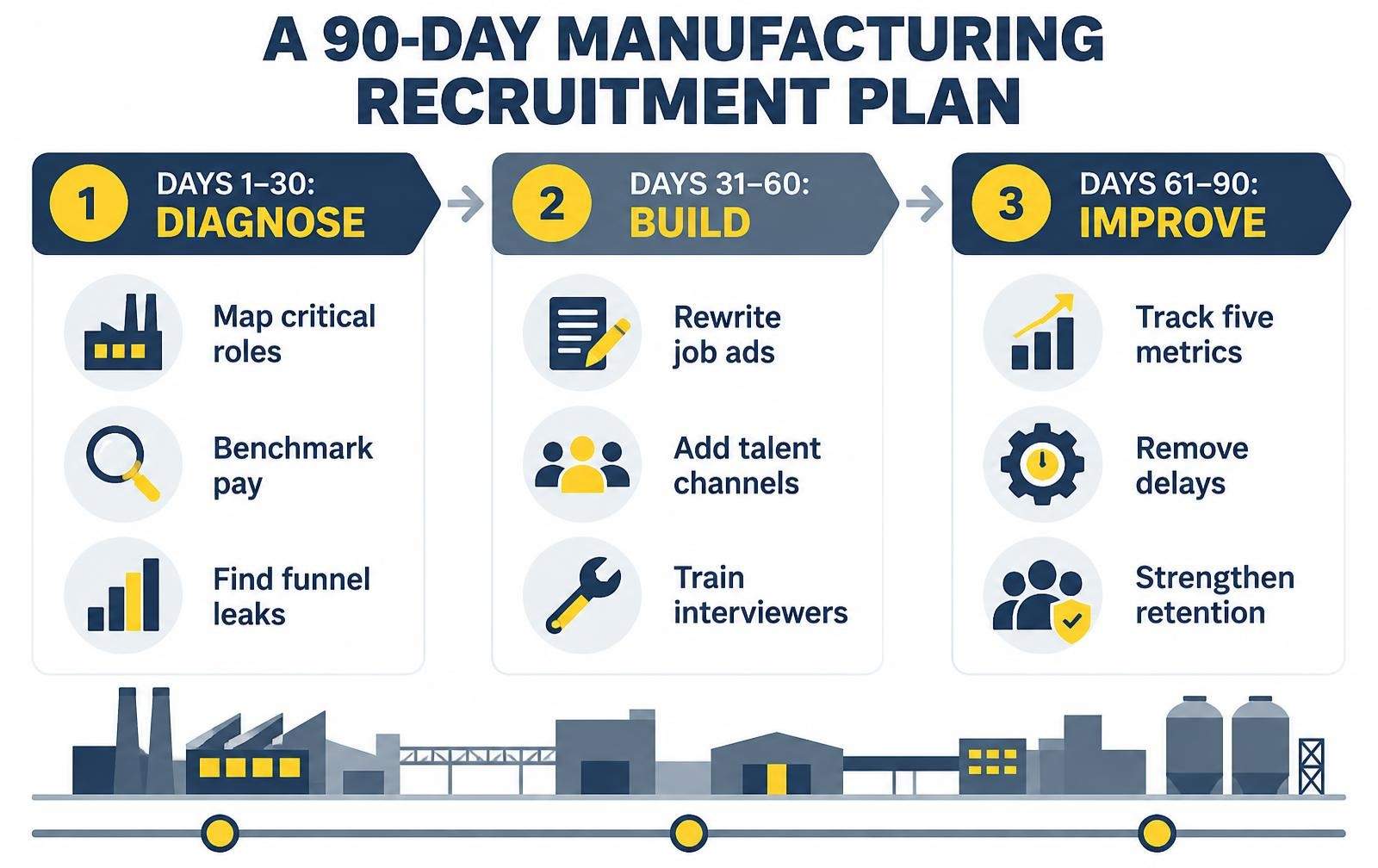
process, and the third to measure and improve.
Five Mistakes That Quietly Shrink Your Candidate Pool
-
01
Using an Old Job Description
The equipment, shift, pay, or team changed, but the ad did not.
-
02
Demanding Direct Industry Experience
Adjacent skills from logistics, field service, the military, or
another plant may transfer well. -
03
Hiding Pay and Schedule
Candidates leave when basic facts appear late.
-
04
Adding Interviews After the Process Starts
Extra rounds signal indecision and increase candidate drop-off.
-
05
Measuring Hires but Not Retention
A fast hire who leaves in 60 days did not solve the problem.
Manufacturing Recruitment FAQ
What is manufacturing recruitment?
Manufacturing recruitment is the process of planning, finding,
assessing, hiring, and retaining people for production, skilled trades,
engineering, quality, maintenance, supply chain, and plant leadership
roles.
How do you recruit manufacturing employees?
Start with a clear role and pay range. Source through referrals, direct
outreach, schools, apprenticeship partners, veterans’ networks, and
local workforce groups. Then use job-relevant assessments and a short,
structured interview process.
Why is manufacturing recruiting so hard?
Many plants compete for the same experienced workers. Skills needs keep
changing, some locations have small labor pools, and shift or
work-environment limits narrow the audience. Slow processes and
inflated requirements make the problem worse.
Which manufacturing recruitment metrics matter most?
Track qualified applicants per opening, time in stage, offer
acceptance, 90-day retention, and quality of hire. Break the results
down by role, shift, source, plant, and hiring manager.
When should a manufacturer use a recruiting firm?
Consider a specialist when a role is urgent, confidential, hard to
find, or outside the internal team’s network. A good partner should
explain the search strategy, market feedback, timeline, and success
measures before work begins.
The best manufacturing recruitment strategy does more than fill today’s
opening. It makes the next critical hire easier.
Build clear roles, several talent lanes, fast decisions, and an
onboarding process people can trust.
Sources and Methodology
This article combines Kallie Boxell’s recruiting perspective with
published workforce data. Different studies define time-to-fill and
time-to-hire differently, so use benchmarks as directional comparisons
rather than interchangeable targets.