Artificial intelligence now touches almost every hiring process in Dallas-Fort Worth, often before a human ever looks at a single application. The real question for employers is no longer whether to use it. It is whether your AI is helping you find great people, or quietly filtering them out.
As a recruiter, I have watched AI go from a novelty to the default in just a couple of years. Used well, it is one of the best things to happen to hiring in a decade. Used carelessly, it will cost you your best candidates, damage your brand, and in Texas, it can now put you on the wrong side of a new state law. So let me walk through what AI genuinely does well, where it fails, and how I coach DFW employers to use it without getting burned.
How Fast AI Took Over Hiring
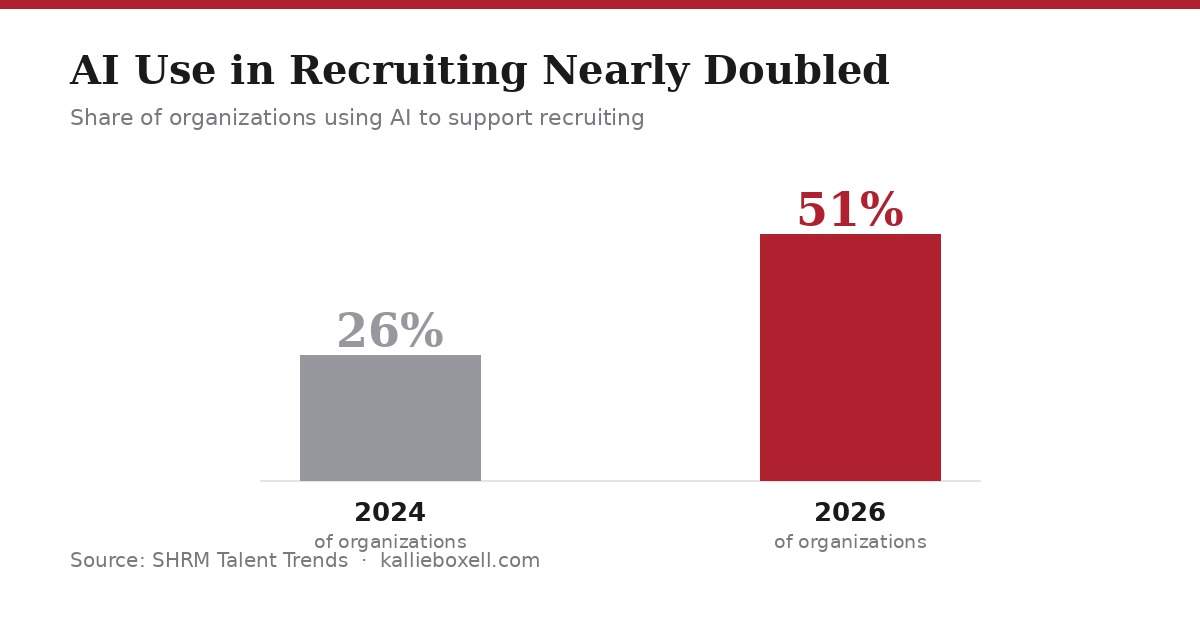
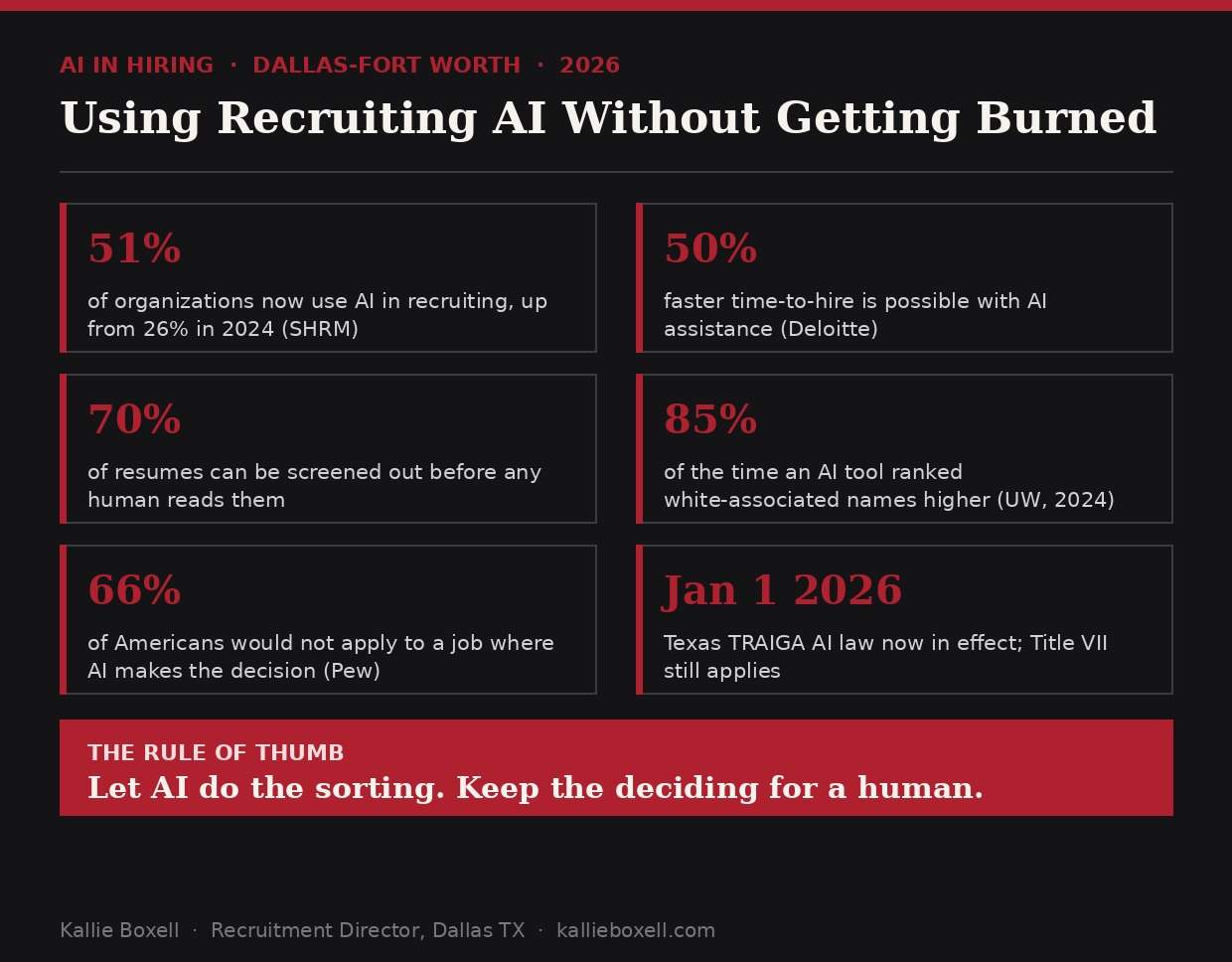
The speed of adoption has been remarkable. According to the Society for Human Resource Management, 51 percent of organizations now use AI to support recruiting, up from just 26 percent in 2024. Within that group, around 44 percent use it specifically to screen resumes. Applicant tracking systems are nearly universal at the top of the market, with JobScan reporting that 97 percent of Fortune 500 companies use one to filter resumes for keywords before a recruiter sees them.
In other words, if you are hiring in DFW today, you are almost certainly using AI, whether you set it up deliberately or it simply came bundled with your software.
What AI Genuinely Does Well
I am not an AI skeptic. For the repetitive, high-volume parts of hiring, it is a real gift, and the data backs that up.
- 89 percent of HR professionals at AI-using organizations say it saves time or increases efficiency (SHRM)
- AI can cut time-to-hire by up to 50 percent (Deloitte)
- Teams report 20 to 40 percent lower cost per hire (SHRM)
- Recruiters save roughly 4.5 hours per week on repetitive tasks (industry survey data)
Where AI earns its keep is the grind: sorting thousands of applications, scheduling interviews, answering routine candidate questions, and drafting first-pass outreach. In a slowing market where every team is asked to do more with less, handing those tasks to software frees your recruiters to do the thing only humans can do, which is actually talk to people and judge fit. That connection is the heart of good hiring, and it is a theme I come back to often, including in my piece on the art of the interview.
The Hidden Cost: Over-Filtering Your Best People
Here is where I see employers get hurt, and it is the part that does not show up in a software demo.
When AI screens resumes, it is only as good as the rules and the data behind it. Set the filters too tight, lean too hard on exact keyword matches, and you will reject strong candidates for superficial reasons. By some estimates, around 70 percent of resumes are screened out before a human ever reads them. Some of those rejections are appropriate. Many are not. The brilliant engineer who described her work differently than your job posting, the career-changer with transferable skills, the veteran whose experience does not map to your keywords, all of them can vanish from your pipeline without anyone noticing.
In a market like ours, that is a serious problem. When Texas companies are already struggling to fill technical roles, as I covered in why Texas companies cannot hire engineers, the last thing you want is an algorithm quietly shrinking an already thin candidate pool. And the cost of getting it wrong runs both directions. Over-filter and you miss great people. Under-filter and trust a flawed tool, and you make the kind of expensive hiring mistake I broke down in the true cost of a bad hire.
The Bias Problem Is Real
There is also a fairness issue that every employer needs to understand. AI learns from historical data, and historical hiring data carries historical bias. A 2024 University of Washington study of AI resume-screening tools found they ranked resumes with white-associated names higher 85 percent of the time. Years earlier, Amazon famously scrapped an experimental recruiting tool after it taught itself to downgrade resumes that included the word “women’s.” These are not edge cases. They are what happens when you let a model trained on the past decide the future without supervision.
The encouraging news is that oversight works. McKinsey found that organizations combining AI with structured human review reported 73 percent better fairness outcomes than either AI-only or human-only processes. The lesson is not to abandon the tool. It is to keep a person in the loop.
Candidates Do Not Trust It Yet
Even setting fairness aside, there is a candidate-experience cost. People are wary of being judged by a machine. Pew Research Center found that 71 percent of Americans oppose AI making final hiring decisions, and 66 percent say they would not even apply for a job where AI makes the hiring call. Gartner found only 26 percent of applicants trust AI to evaluate them fairly.
Dallas-Fort Worth hiring has slowed, but the people you most want are still in demand and still have choices. If your process feels cold, opaque, or automated to the point of being impersonal, strong candidates will simply drop out. A great hire is still a relationship, and relationships are the foundation of retention, which, in this market, matters more than ever. I made that full argument in why retention beats recruiting in a slowing DFW market.
The Texas Compliance Reality in 2026
This is the part too few local employers have caught up on, so pay attention. The legal ground under AI hiring shifted in 2026, and Texas is now part of the story.
- Texas has its own AI law. The Texas Responsible Artificial Intelligence Governance Act took effect on January 1, 2026. It prohibits developing or deploying AI with the intent to unlawfully discriminate against a protected class, and it is enforced by the Texas Attorney General, with penalties that can reach tens of thousands of dollars per day for continuing violations.
- Federal law still applies. Although the EEOC withdrew its specific technical guidance on AI tools in 2025, Title VII, the Age Discrimination in Employment Act, and the Americans with Disabilities Act remain fully in force. If an AI tool produces a discriminatory outcome, the employer is still responsible. Regulators use the four-fifths rule, comparing selection rates across groups, as a signal of adverse impact. An earlier federal settlement over an AI tool that auto-rejected older applicants ended with a six-figure payout, so this is not theoretical.
- Other states are moving too. New York City already requires independent bias audits of automated hiring tools. Illinois expanded its Human Rights Act in 2026 to bar discriminatory AI in employment. If you hire across state lines, their rules can reach you.
The practical takeaway is simple. If you use AI to screen or rank candidates, you are responsible for what it does, and in Texas that responsibility now has a statute attached to it.
How I Coach DFW Employers to Use AI Well
None of this means you should unplug the technology. It means you should use it like a professional tool rather than an autopilot. Here is the approach I recommend.
- Let AI assist, not decide. Use it to source, sort, schedule, and surface candidates. Keep the real decisions, especially the final ones, with a human being.
- Loosen your filters. Screen for genuine must-haves, not a wish list of exact keywords. Build in a way to catch strong non-obvious candidates rather than auto-rejecting them.
- Write for humans and machines. Clear, honest job descriptions help the AI match the right people and help candidates self-select. That is more important than ever, and it is exactly what I laid out in how to write job descriptions that attract top talent.
- Audit for adverse impact. Periodically check whether your tool screens out protected groups at different rates. Document that your criteria are job-related. This is both good ethics and, in 2026, good legal hygiene.
- Protect the candidate experience. Be transparent that AI is part of your process, keep real human touchpoints, and never let a candidate feel they were rejected by a machine with no recourse.
The Bottom Line
Artificial intelligence is now a permanent part of hiring in Dallas-Fort Worth, and on balance that is a good thing. It removes drudgery, speeds up the process, and lets recruiters spend their time where it counts. But it is a tool, not a decision-maker. It cannot read character, gauge motivation, or judge whether someone will thrive on your team. It will also faithfully reproduce whatever bias it was trained on, and in Texas it now comes with legal obligations.
The employers who will win talent in this market are not the ones who automate the most. They are the ones who use AI to handle the volume and then put human judgment exactly where it belongs. Let the machine do the sorting. Keep the deciding for yourself.
Society for Human Resource Management (SHRM) Talent Trends; Deloitte Human Capital Trends; Pew Research Center (2023); Gartner (2024); University of Washington (2024); McKinsey (2024); JobScan; Texas Responsible Artificial Intelligence Governance Act (HB 149, effective January 1, 2026); U.S. Equal Employment Opportunity Commission (Title VII guidance).